

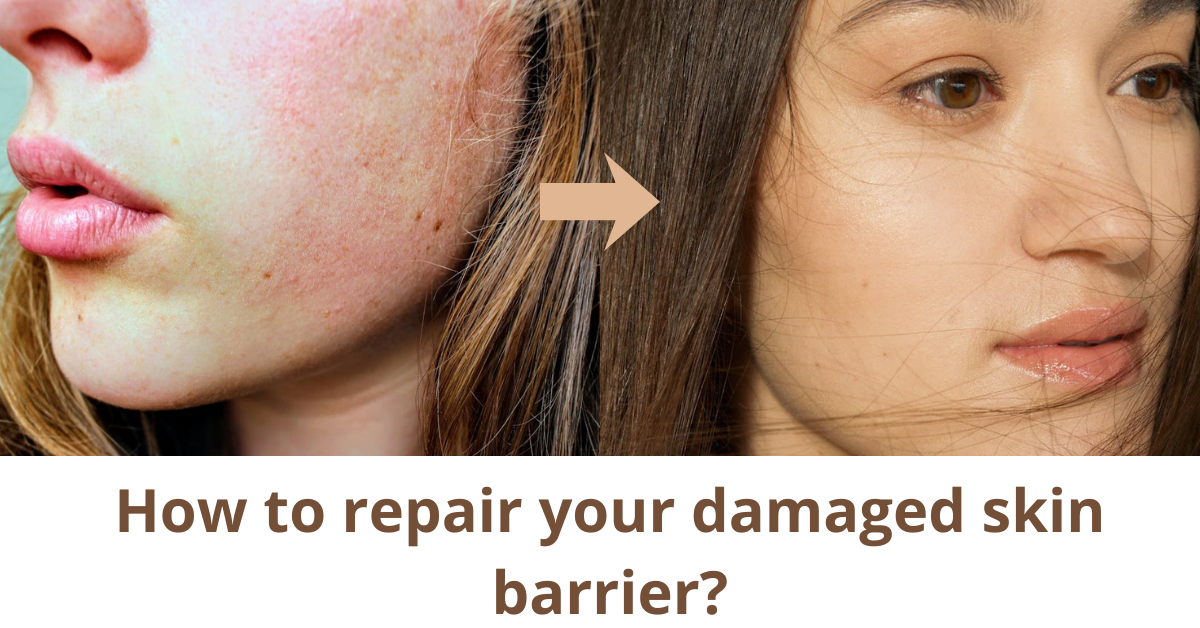
Is your skin red, dry, or breaking out more than usual? Your skin barrier might be damaged – Learn how to repair a damaged skin barrier step by step, the best ingredients to use, what to avoid and simple skincare routines.
Table of Contents
What is the skin barrier?
Your skin is made up of two layers: epidermis (outer layer) and dermis (the inner layer).
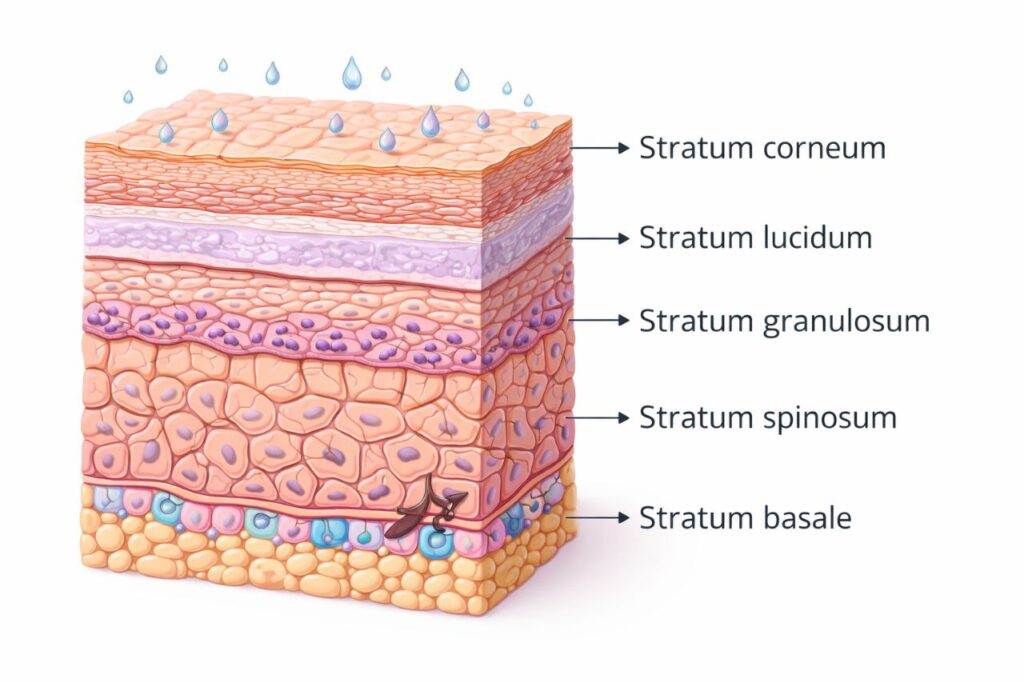
You know epidermis itself is composed of 5 different layers (from outer to inner) :
- Stratum Corneum
- Stratum Lucidum
- Stratum Granulosum
- Stratum Spinosum
- Stratum Basale
And out of all these layers, Stratum Corneum (the outermost) acts as your skin barrier.
The role of stratum corneum:
- Stratum corneum is a selectively permeable membrane means it selects the ingredients which can cross it or which one can’t, like a security guard in front of your house he only allows the family members or relatives not the outsiders. So, it allows water and other useful substances for your skin and inhibit the entry of bacteria, pollutants and toxins. And this selective entry or exit is due to the corneum lipids: Ceramides, cholesterol and fatty acids.
- It locks water inside the skin and prevents water loss because of the natural humectant NMF (natural moisturizing factor) present in the cells of the membrane. NMF binds with the water and maintains the skin elasticity and natural shedding of the skin.
- It is slightly acidic in nature with pH ranges from 4-6 (pH less than 5 is generally considered better) due to which the growth of harmful bacteria, fungi is inhibited and natural flora flourishes.
- It has amazing power of self repair up to a certain extent. If the water loss increases or we can say NMF got decreased then a protein named Filaggrin in Stratum corneum breaks down to form NMF and hence the activity restores.
Why a healthy skin barrier is important for acne prone skin:
A damaged skin barrier allows the entry of harmful bacteria, toxins and pollutants which further irritate the skin and causes acne breakouts. Plus increases the oil production because of the water loss and hence more acne. So a healthy skin barrier – less breakouts.
Signs your skin barrier is damaged:
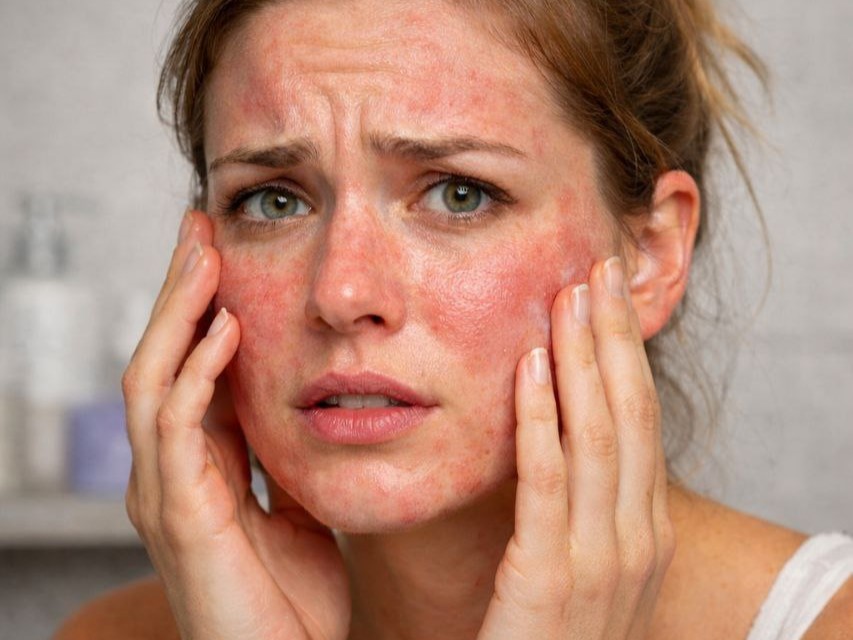
- Your skin will be irritated and sensitive.
- Whenever you apply a product, your skin becomes red or burn.
- Tight or dry skin
- Increase in acne breakouts
What causes a damaged skin barrier?
Damage to your skin barrier can be due to both internal factors and external factors.
–Internal factors include your genetics or any skin condition like psoriasis, rosacea etc.
–External factors are how you and your surrounding environment treat your skin which includes:
1. Over exfoliation – Exfoliation is basically removing your dead skin cells but if you overdo it (recommended 1-2 times a week), your normal skin cells will get damaged.
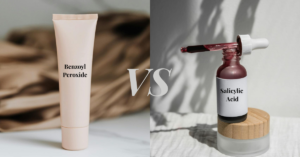
2. Overuse of benzoyl peroxide or salicylic acid: Benzoyl peroxide acts by killing bacteria, if you use it more than recommended then, it will damage your natural flora of your skin and it also increases water loss from your skin. And salicylic acid overuse can cause stripping of your lipid layer which result in water loss and damage to your skin barrier.
3. Use of harsh cleansers or foaming face washes: Harsh cleansers means they have more alkaline pH. They will disturb your normal acidic pH of your skin and this will reduce your normal lipids, induce inflammation and support the growth of acne-causing bacteria.
4. Skipping moisturizer: Moisturizer forms a barrier to water loss, it maintains the integrity of your stratum corneum and replace your skin lipids. So if you skip it, the loss is yours.
5. Overuse of retinoids: Retinoids acts by increasing the cell turn over means increases the proliferation of cells due to which the upper layer of skin cells get removed quickly and prevent the deposition of dead skin cells and hence clogging of pores.
So, the overuse of retinoids increases the proliferation, removal of your upper layer of skin and hence, water loss. In the end, decision is yours.
6. Weather changes and pollution: During winters, low humidity, harsh winds and hot showers increases the water loss from your skin and can damage your skin barrier. Pollutants like nitrogen dioxide, sulphur dioxide, particulate matter, traffic smoke or ozone penetrates into the skin which causes irritation and water loss.
⚠️ STOP! Don’t Make These Skin Barrier Mistakes
These are the most common mistakes that keep your skin barrier from healing:
- ❌ “Just one more active won’t hurt” — YES IT WILL. Stop ALL actives.
- ❌ Washing your face 3+ times a day — More washing = more damage.
- ❌ Using hot water — Strips natural oils. Use lukewarm only.
- ❌ Switching products every week — Barrier repair takes 4-12 weeks.
- ❌ Scrubbing or physical exfoliation — Treat your skin like tissue paper.
- ❌ Layering 10 “healing” products — Simple routine beats complicated.
- ❌ Skipping sunscreen — Non-negotiable. Period.
Bottom line: Your skin doesn’t need more stuff. It needs less irritation and more time.
How to repair a damaged skin barrier (step by step)?
Step 1: STOP all the active ingredients:
If you are using retinoids, retinols, benzoyl peroxide or salicylic acid then, stop them immediately.
Step 2: Switch to a gentle low pH cleanser:
Choose a low pH (4.7-5.5) cleanser that make your skin acidic, calm down the irritation, redness and remove excess oil and dirt gently.
Step 3: Use a barrier repair moisturizer:
This is really very important part. Your moisturizer makes a barrier, will prevent further water loss, improves dryness and redness. Please look for ceramides, cholesterol and fatty acids in your moisturizer because they are naturally present in your skin and will heal your skin barrier faster.
Step 4: Avoid overwashing your face:
Limit it to only 2 times per day (morning and night) with your gentle cleanser but if still you’re experiencing irritation then, you can only use in the night and wash with simple water in the morning.
Step 5: Always use sunscreen:
When your barrier becomes damaged, it is more prone to penetration and in that case, your skin becomes far more vulnerable to UV damage so, you must use sunscreen which will protect you.
Step 6: Be patient (healing takes time):
I know skin conditions make you irritable and anxious when nothing works out, but trust me all these will work out and for that you really have to be patient and consistent with your skincare. Well, who knows better than a very impatient and an anxious person?
Skin Barrier repair Routine
Morning Routine
A gentle low pH cleanser → Toner (Watery consistency or you can use rice toner made at home) → a ceramide rich moisturizer → a Light broad spectrum Sunscreen
Night Routine
Gentle cleanser → Toner → a Niacinamide serum → Ceramide rich moisturizer
Best ingredients to repair skin barrier faster
1.Ceramides: It is one of the natural lipids that make skin barrier and prevent water loss so try to use the moisturizer with ceramides. It will help in faster healing.
2.Niacinamide: It helps in the production of ceramides and calms the skin by reducing redness and inflammation. Low concentration (2-5%) niacinamide would help in better healing. Try to avoid higher concentrations.
3.Panthenol: It is a great humectant (binds with water) and emollient (reduces water loss). So it will overall increase the amount of water in your skin.
4.Centella asiatica (CICA): It is an anti inflammatory agent means it will reduce the redness, irritation or burning of your skin. Ultimately it will soothe your skin.
5.Hyaluronic acid: It is also a humectant, draws water from dermis and increase water content in your stratum corneum.
Ingredients to avoid while healing your skin barrier:
1. Benzoyl peroxide: It is a very strong active ingredient, causes dryness, redness and irritation because it increases the water loss.
2. Retinoids: It also increases the water loss and dryness by increasing cell turnover.
3. Salicylic acid (BHA): Overuse or higher concentrations (>2%) can cause irritation, dryness and redness by disrupting lipid layer.
4. Alcohol based products: They disrupt your skin’s natural oils or lipids.
5. Fragrance: Disrupt the lipids and increase water loss.
How long does it take to repair a damaged skin barrier?
Well, it depends on your skin and the severity of your damage. If your skin is sensitive or the damage is severe it may take 8-12 weeks or more. Some people may take approximately 20 weeks to fully recover.
If the damage is mild, it may take up to 4 weeks to heal. As I’ve said it completely depends on your skin, varies from person to person. So, please be patient and consistent. You’ve got this!!
When to see a dermatologist
You should see a dermatologist when there is peeling of skin and your skin gets infected. Also if your damaged skin barrier doesn’t improve in 2-3 months. Please do visit a dermatologist then.
Can you repair your skin barrier while treating acne?
The answer is pause, heal and resume.
If you’re having both acne and a damaged skin barrier then, first you need to pause all the active ingredients you’re using to treat the acne because it will further damage your skin barrier and it will cause more breakouts. So, first break this vicious cycle.
First start with repairing of skin barrier, use ceramide rich moisturizer, a gentle low pH cleanser and a sunscreen. You can look for humectants too. This will reduce redness, irritation and dryness. Wait till your skin barrier heals completely. And as your skin barrier starts to heal, you will see that some percent of acne is also gone because your damaged skin barrier was causing them.
Now, slowly starts to incorporate acne treating ingredients one by one. Start with a patch test – apply small amount of ingredient to a small area of face, if it doesn’t cause any irritation or redness then apply it all over the face. In this way you can first heal the skin barrier and then acne.
FAQs
Can a damaged skin barrier heal on its own?
Yes, your skin barrier can heal on its own, but it will take much longer without proper care. The stratum corneum has self-repair mechanisms, but if you continue using harsh products or don’t provide the right ingredients (like ceramides), healing can take 3-6 months instead of 4-8 weeks.
What does a damaged skin barrier look like?
A damaged skin barrier typically shows these visible signs: redness or inflammation, dry and flaky patches, increased sensitivity (products that didn’t irritate before now burn), rough texture, persistent acne breakouts, and an overall dull appearance. Your skin may also feel tight after cleansing or produce excess oil.
Should I still moisturize if my skin is oily and barrier-damaged?
Of course. Your skin produces excess oil because your barrier is damaged and losing water. Skipping moisturizer will make it worse so, choose a lightweight, ceramide-rich moisturizer that won’t clog pores. As your barrier heals, you’ll notice that your skin becomes less oily naturally.
Can I use niacinamide on a damaged skin barrier?
Yes, but only in low concentrations (2-5%). Niacinamide actually helps repair your skin barrier by boosting ceramide production and reducing inflammation. However, high concentrations (10% or more) can irritate damaged skin.
How do I know if my skin barrier is healed?
You’ll know when your skin no longer stings or burns when applying products, redness and dryness have gone, your skin feels soft and smooth instead of tight or rough, you’re not experiencing random breakouts or irritation, and your skin maintains moisture throughout the day without feeling oily or dry.
Can I wear makeup with a damaged skin barrier?
You can, but minimize it during healing. If you must wear makeup, choose mineral-based foundations without fragrance or alcohol, and avoid long-wear or matte formulas that can be drying. Always use a gentle, oil-based cleanser to remove it.
Conclusion
Repairing your skin barrier isn’t glamorous — it’s slow, simple, and requires you to do less rather than more. But that’s exactly what makes it work.
Strip your routine back to the basics: a gentle low-pH cleanser, a ceramide-rich moisturizer, and a sunscreen. Stop the actives, be consistent, and give your skin the time it needs to heal itself. Remember, your skin has an incredible ability to repair — you just have to stop getting in its way. Your skin will thank you for it.
Pingback: Why is my Acne worse after starting salicylic acid? (Purging vs breakout explained) - Bloom